Bearings
Bearings support and locate moving shafts or structures while controlling friction and load. Different rolling, sliding and magnetic designs handle radial, axial, combined, oscillating or overturning loads.
14 products
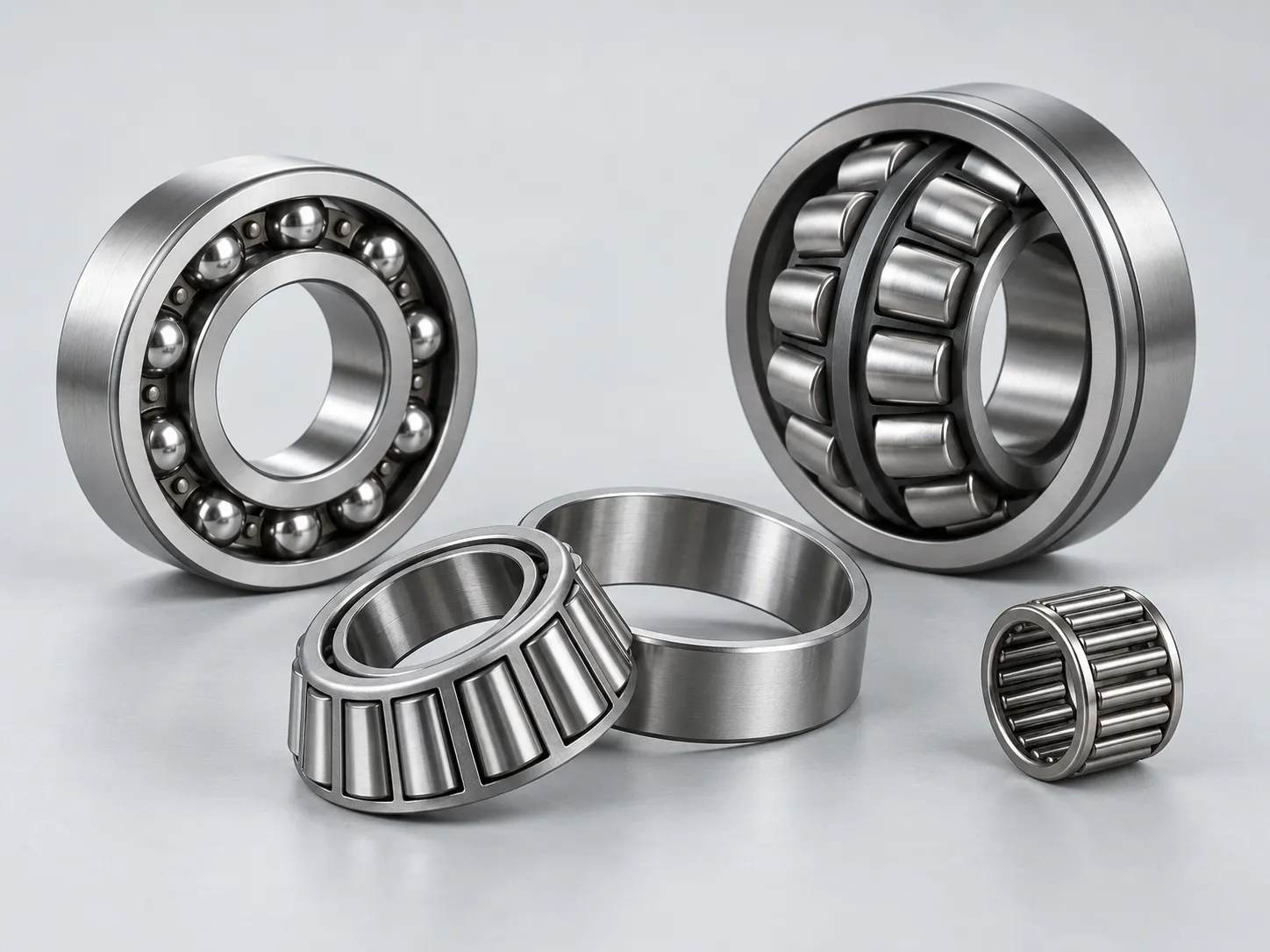
Browse bearings
Deep Groove Ball BearingsDeep groove ball bearings are rolling bearings with continuous raceway grooves and one or two rows of balls. Angular Contact Ball BearingsAngular contact ball bearings are rolling bearings whose inner and outer raceways are offset axially to create an angled load path. Self-Aligning Ball BearingsSelf-aligning ball bearings are compact double-row bearings with two inner-ring raceways and one spherical outer raceway. Cylindrical Roller BearingsCylindrical roller bearings are rolling bearings whose straight rollers make line contact with their raceways. Tapered Roller BearingsTapered roller bearings are separable rolling bearings with conical rollers and raceways converging towards a common point. Spherical Roller BearingsSpherical roller bearings are double-row bearings with barrel-shaped rollers running against a common spherical outer raceway. Needle Roller BearingsNeedle roller bearings are compact rolling bearings that use many long, small-diameter cylindrical rollers. Thrust BearingsThrust bearings are rolling bearings arranged to carry load along the shaft axis. Mounted Bearings & HousingsMounted bearings and housings are ready-to-install supports that locate a rolling bearing in a bolted cast or pressed body. Slewing BearingsSlewing bearings are large-diameter rolling rings that support slow rotation or oscillation under combined axial, radial and overturning loads. Plain Bearings & Rod EndsPlain bearings and rod ends are sliding-contact supports for oscillation, tilting and low-speed movement. Thin-Section BearingsThin-section bearings are large-bore rolling bearings with a small, often constant cross-section across a size series. Super-Precision Spindle BearingsSuper-precision spindle bearings are tightly controlled rolling bearings designed for accurate, rigid rotation in machine-tool and instrument spindles. Magnetic BearingsMagnetic bearings are contact-free supports that suspend a rotating shaft using controlled magnetic forces. Questions about bearings
What information identifies a replacement bearing?
Send the complete bearing designation if it is readable. Otherwise provide bore, outside diameter and width, plus seal or shield style. Also state the load direction, speed, mounting fit, internal clearance, lubrication and any locating features such as snap-ring grooves or tapered bores.
Can bearing dimensions alone determine the right type?
Dimensions narrow the options but do not fully define load capacity, internal geometry, clearance, precision or sealing. Two bearings with the same envelope may serve different duties. The machine position, existing designation and operating conditions should therefore accompany measured dimensions.
Why do bearing fits and clearance matter?
Shaft and housing fits prevent rings from creeping under load, while internal clearance allows for fit expansion and operating heat. An unsuitable combination can create looseness or excessive preload. Confirm the rotating load, materials, temperatures and required running accuracy before choosing either.