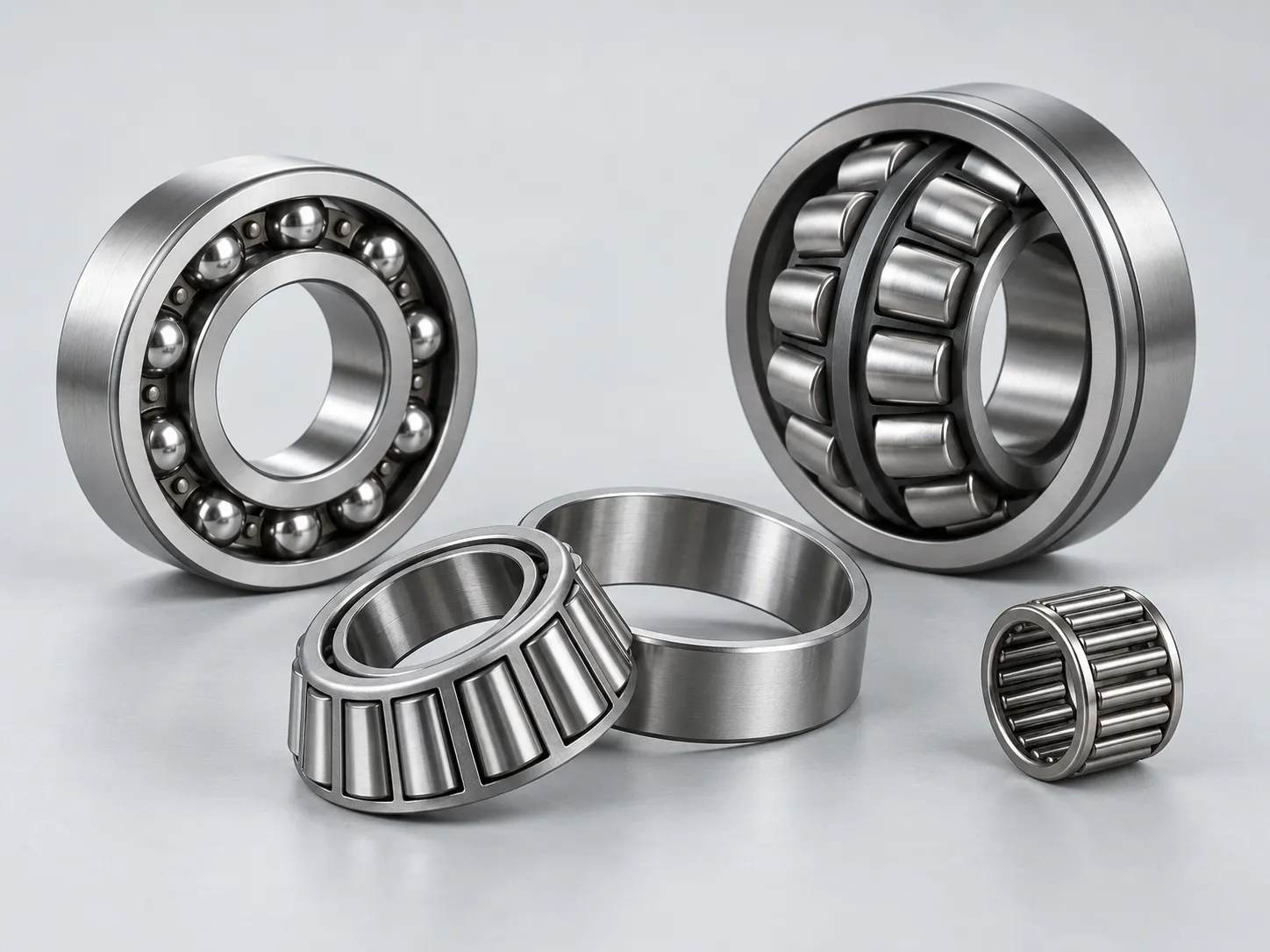
Representative image of magnetic bearings
Representative image

Magnetic Bearings

Magnetic bearings are contact-free supports that suspend a rotating shaft using controlled magnetic forces. Active systems combine electromagnets, position sensors and a controller, while passive elements may assist the magnetic circuit, enabling clean, low-wear rotation in specialised high-speed or low-vibration machinery.

Key facts

Family
Bearings
Common types
Active radial bearing, Active axial bearing, Hybrid magnetic bearing, Passive magnetic support, Backup bearing assembly
Materials
Laminated electrical steel, Copper windings, Permanent magnet alloy, Engineering polymer insulation, Bearing steel backup rings
Used in
High-speed compressors, Vacuum pumps, Turbomachinery, Flywheel systems, Clean-process equipment

Types

  • Active radial bearing
  • Active axial bearing
  • Hybrid magnetic bearing
  • Passive magnetic support
  • Backup bearing assembly

Materials

Applications

  • High-speed compressors
  • Vacuum pumps
  • Turbomachinery
  • Flywheel systems
  • Clean-process equipment

What to send for a quote

  • shaft geometry
  • radial and axial loads
  • speed range
  • control and sensor requirements
  • machine environment

Questions about magnetic bearings

What should I send to identify magnetic bearings?

Send shaft geometry, radial and axial loads, speed range, control and sensor requirements, machine environment. Provide machine and control architecture details because magnetic bearing components are not selected by boundary dimensions alone. A clear photograph, drawing or readable reference can resolve details that dimensions alone do not show.

How should I select magnetic bearings?

Treat the bearing, sensors, controller, power supply and backup bearings as one engineered system matched to rotor dynamics. Confirm the mating parts and operating environment before ordering, since an apparently similar size can use a different profile, material or internal arrangement.

Last updated: