Lubrication
Lubrication products separate moving surfaces, control friction, carry heat and protect components from wear or corrosion. Application equipment ranges from hand tools and single-point devices to monitored centralised systems.
9 products
Browse lubrication
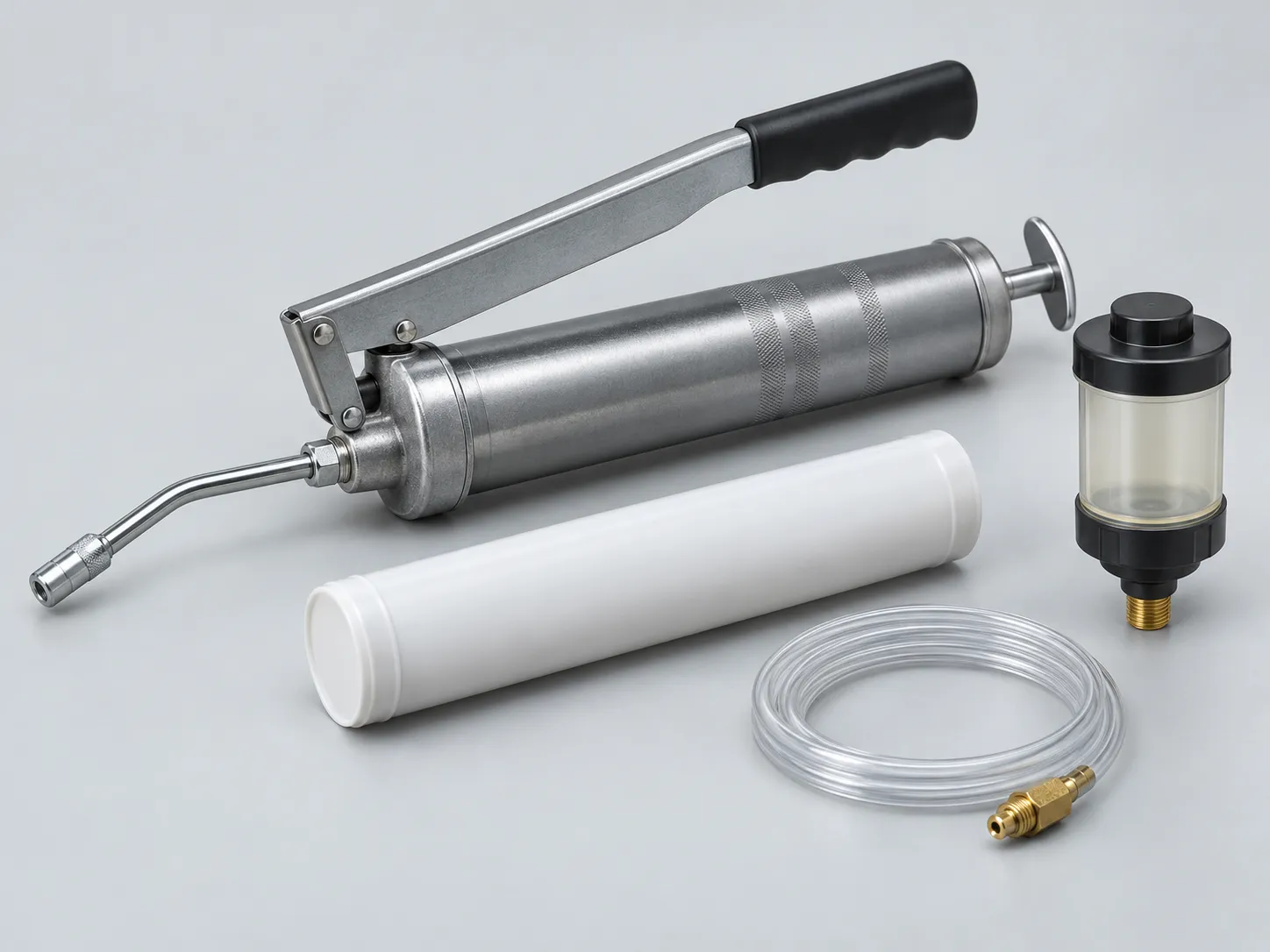
Industrial GreasesIndustrial greases are semi-solid lubricants that hold base oil within a thickener structure and carry performance additives. Industrial Lubricating OilsIndustrial lubricating oils are liquid formulations that separate moving surfaces, carry heat and transport contaminants towards filters or sumps. Manual Lubrication ToolsManual lubrication tools are hand-operated devices used to store, transfer, meter and apply grease or oil at individual machine points. Single-Point Automatic LubricatorsSingle-point automatic lubricators are self-contained dispensers mounted near one bearing or machine lubrication point. Single-Line Lubrication SystemsSingle-line lubrication systems are intermittent networks in which one main supply line feeds metering units at multiple points. Dual-Line Lubrication SystemsDual-line lubrication systems are centralised networks that alternately pressurise two main lines to operate positive metering valves. Progressive Lubrication SystemsProgressive lubrication systems are centralised networks whose feeder pistons move in a fixed sequence, dividing pump output among several points. Oil & Air Lubrication SystemsOil and air lubrication systems are metered delivery arrangements that introduce small oil quantities into a continuous compressed-air stream. Chain Lubrication SystemsChain lubrication systems are controlled delivery arrangements for moving chain pins, bushes and rollers. Questions about lubrication
What details are needed to select a lubricant?
Identify the component, load, speed, temperature, environment and relubrication method. For oil, include viscosity grade and system type. For grease, include consistency, base oil needs and thickener compatibility. Any food, water, chemical or cleanliness constraint should be stated clearly.
Can different greases be mixed?
Mixing is not automatically safe because base oils, thickeners and additives can be incompatible. The blend may soften, harden or separate. Check compatibility data, remove as much old grease as practical, and monitor the component closely whenever a controlled change of grease is required.
When is a centralised lubrication system useful?
A centralised system helps when a machine has many points, frequent lubrication needs, moving equipment or locations that are difficult to access safely. System choice depends on lubricant, distances, point quantities, metered volumes, monitoring needs and the way the machine operates.