Rotary & Mechanical Seals
Rotary seals retain lubricant or process fluid around a turning shaft and help exclude dirt or moisture. Mechanical seals use a controlled interface between precision faces to seal pumps, mixers, compressors and similar rotating equipment.
12 products
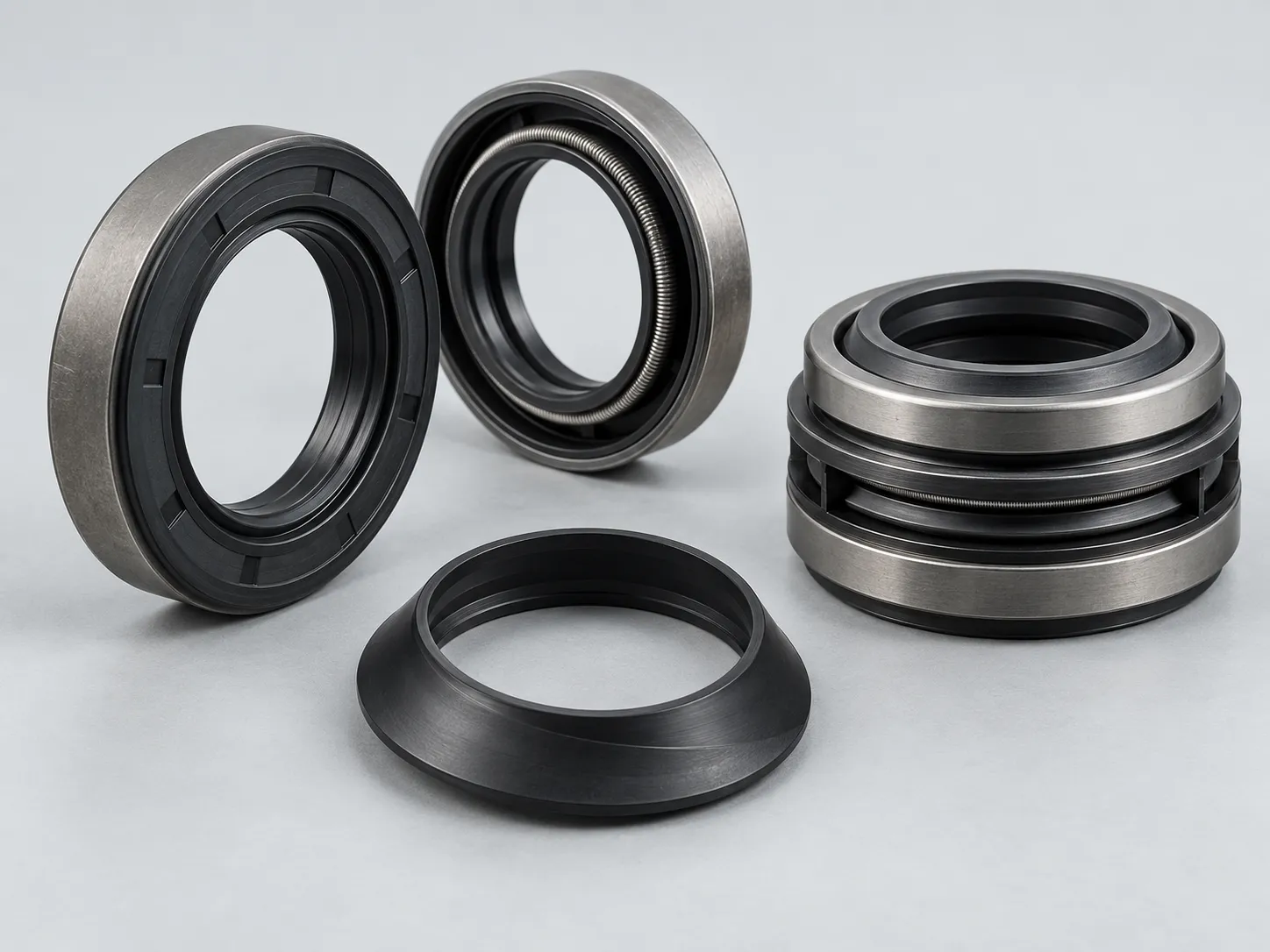
Browse rotary & mechanical seals
Radial Shaft Oil SealsA radial shaft oil seal is a circular housing-mounted seal whose flexible lip runs on a rotating shaft. Cassette SealsA cassette seal is a unitised rotary cartridge containing sealing lips, a protective case and its own running sleeve. V-RingsA V-ring is an all-elastomer rotary seal that stretches onto a shaft and turns with it. Axial Face SealsAxial face seals are paired metal sealing rings loaded together by shaped elastomer rings. Roll Neck SealsA roll neck seal is a large rotary lip seal fitted around a rolling mill neck within the chock assembly. PTFE Rotary Lip SealsA PTFE rotary lip seal is a shaft seal with a formed or machined fluoropolymer lip retained in a rigid case. Spring-Energised SealsA spring-energised seal is a machined polymer jacket containing a corrosion-resistant metal spring. Coil Spring Mechanical SealsCoil spring mechanical seals are face-seal assemblies that use one large spring or several small springs to keep rotating and stationary faces together. Rubber Bellows Mechanical SealsA rubber bellows mechanical seal is a non-pusher face seal whose flexible elastomer bellows provides secondary sealing and transmits rotation. PTFE Bellows Mechanical SealsA PTFE bellows mechanical seal is an externally mounted non-pusher seal whose convoluted fluoropolymer bellows separates vulnerable metal parts from the process. Metal Bellows Mechanical SealsA metal bellows mechanical seal is a non-pusher face seal with formed or edge-welded metal convolutions that provide axial flexibility and closing force. Cartridge Mechanical SealsA cartridge mechanical seal is a preassembled unit containing faces, sleeve, gland, springs and temporary setting devices. Questions about rotary & mechanical seals
What shaft details matter for a rotary seal?
Provide shaft diameter, housing bore, installed width, shaft finish, rotation direction and speed. State the retained fluid, temperature and external contamination. For a mechanical seal, also include the chamber, stationary seat and working length dimensions, plus the pump or mixer arrangement.
What causes a rotary lip seal to leak?
Common causes include a worn or grooved shaft, incorrect lip direction, poor housing fit, contamination, eccentric running and unsuitable material. A dry lip can also be damaged during start-up. Inspect the counterface and installation path before assuming the replacement seal itself is faulty.
How are mechanical seal face materials selected?
Face pairing depends on the process liquid, solids, lubrication at the faces, heat generation and equipment duty. Carbon, ceramic, silicon carbide and tungsten carbide offer different friction and wear behaviour. Secondary elastomers and metal parts must also be compatible with the same fluid.