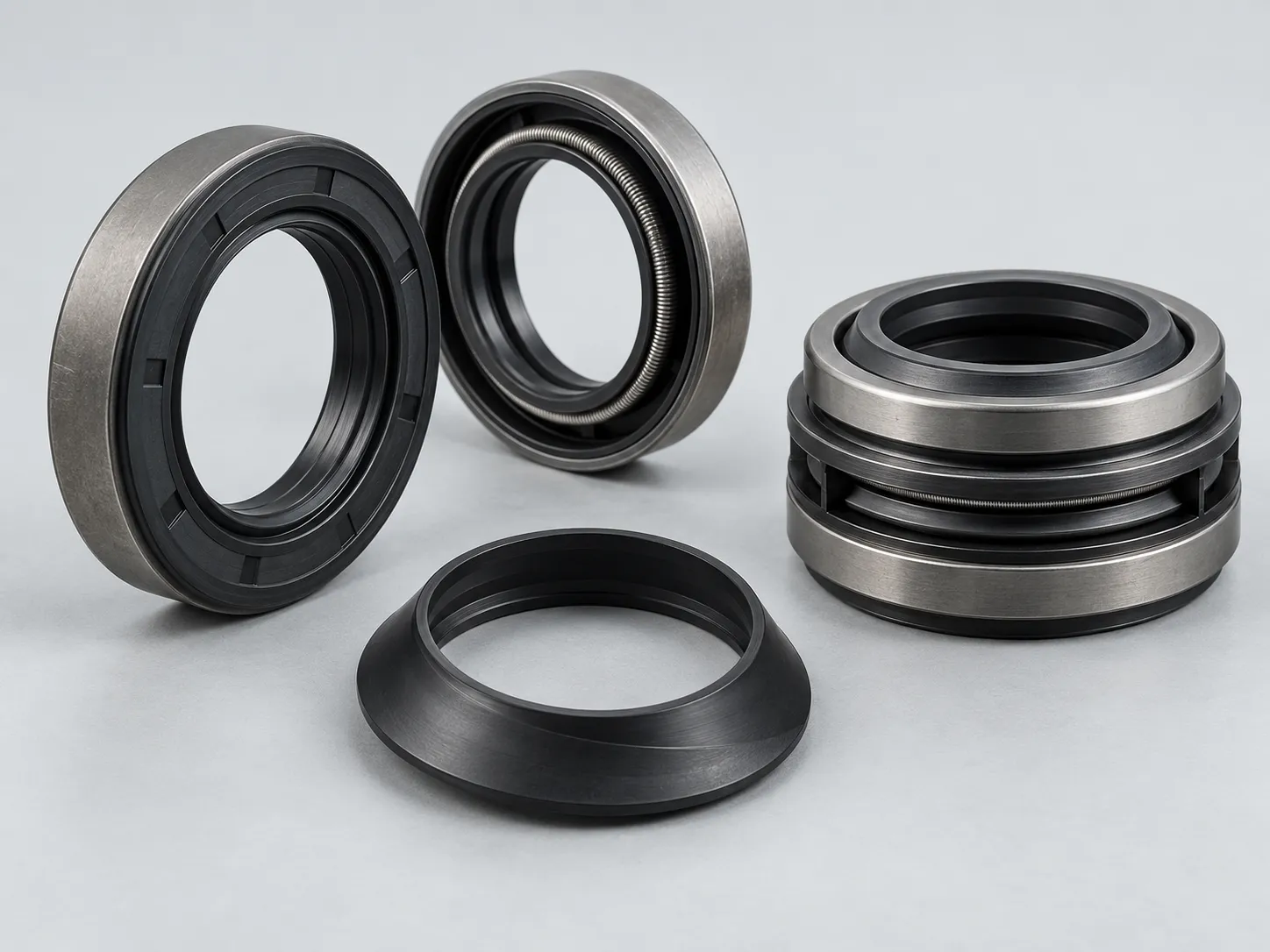
Representative image of axial face seals
Representative image

Axial Face Seals

Axial face seals are paired metal sealing rings loaded together by shaped elastomer rings. Their precision faces form a robust rotating barrier while the elastomers provide axial force and static sealing, protecting low-speed bearing compartments against abrasive soil, rock dust and slurry.

Key facts

Common types
O-ring energised pair, Trapezoidal energiser pair, Clamp-style face seal, Split axial seal
Materials
Alloy cast iron, Forged bearing steel, NBR, HNBR, FKM (fluoroelastomer), Silicone
Used in
Track rollers, Final drives, Tunnel machinery, Mining conveyors, Concrete mixers

Types

  • O-ring energised pair
  • Trapezoidal energiser pair
  • Clamp-style face seal
  • Split axial seal

Materials

Applications

  • Track rollers
  • Final drives
  • Tunnel machinery
  • Mining conveyors
  • Concrete mixers

What to send for a quote

  • seal bore and outside diameter
  • cavity profile
  • assembled working height
  • equipment position
  • lubricant and debris

Questions about axial face seals

What should I send to identify axial face seals?

Send seal bore and outside diameter, cavity profile, assembled working height, equipment position, lubricant and debris. Send both metal and elastomer ring dimensions as a set, plus a cavity drawing or clear equipment reference. A clear photograph, drawing or readable reference can resolve details that dimensions alone do not show.

How should I select axial face seals?

Match ring geometry and elastomer loading to the housing ramps, lubricant, speed, shock and abrasive environment. Confirm the mating parts and operating environment before ordering, since an apparently similar size can use a different profile, material or internal arrangement.

Last updated: