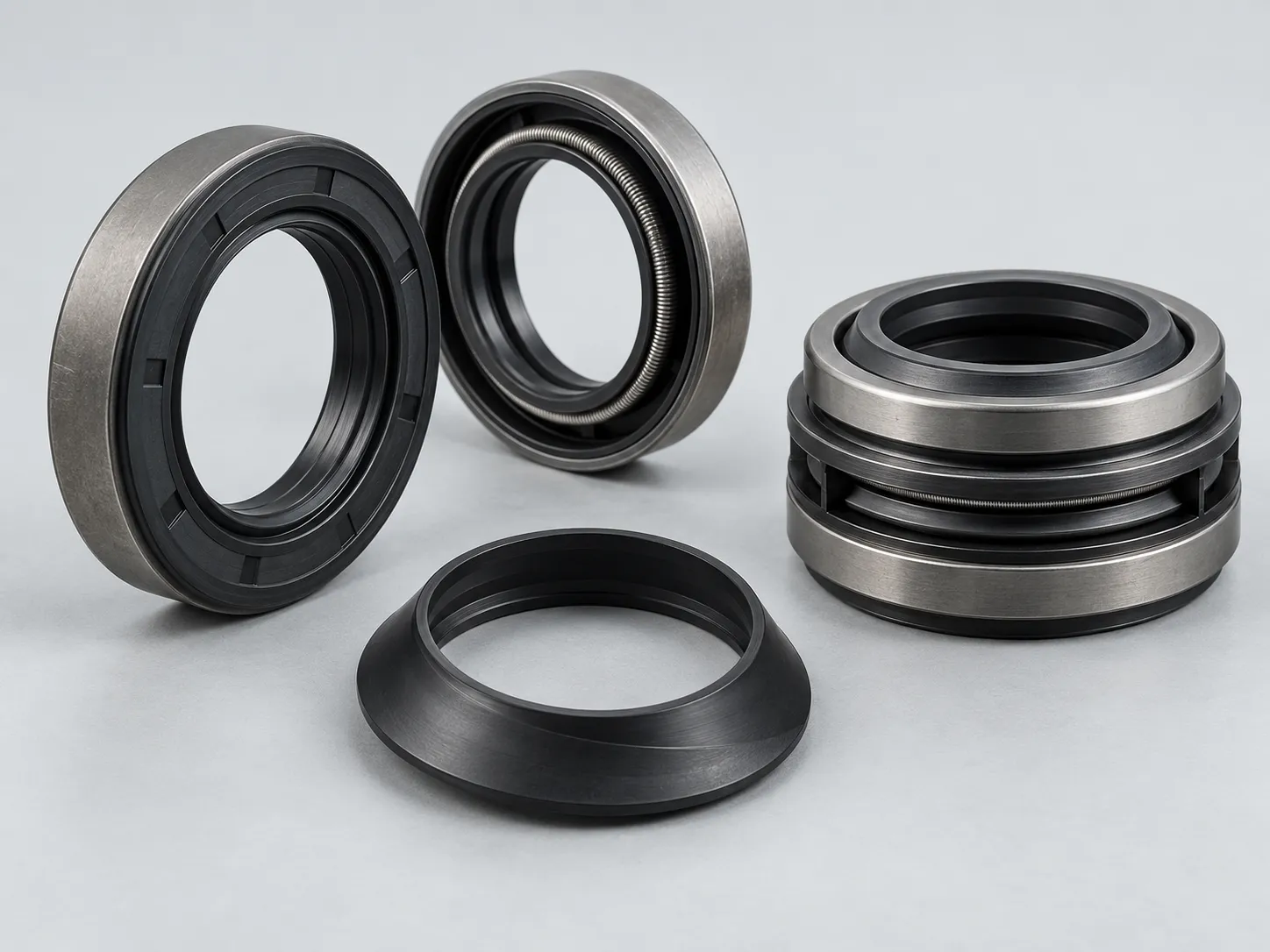
Representative image of v-rings
Representative image

V-Rings

A V-ring is an all-elastomer rotary seal that stretches onto a shaft and turns with it. Its flexible conical lip contacts a stationary face, providing axial exclusion while the rotating body also flings water and dirt away from the bearing or housing.

Key facts

Common types
Standard profile, Heavy-duty profile, Compact profile, Wide profile, Split V-ring
Materials
NBR, FKM (fluoroelastomer), EPDM, Silicone
Used in
Electric motors, Conveyor pulleys, Rolling mills, Industrial fans, Agricultural machinery

Types

  • Standard profile
  • Heavy-duty profile
  • Compact profile
  • Wide profile
  • Split V-ring

Materials

Applications

  • Electric motors
  • Conveyor pulleys
  • Rolling mills
  • Industrial fans
  • Agricultural machinery

What to send for a quote

  • shaft diameter
  • mounting distance
  • counterface dimensions
  • contamination type
  • temperature range

Questions about v-rings

What should I send to identify v-rings?

Send shaft diameter, mounting distance, counterface dimensions, contamination type, temperature range. Confirm that the lip seals against a perpendicular face, since a V-ring does not run radially inside a housing bore. A clear photograph, drawing or readable reference can resolve details that dimensions alone do not show.

How should I select v-rings?

Select profile and compound from shaft stretch, available axial space, counterface condition, speed and exposure to water or chemicals. Confirm the mating parts and operating environment before ordering, since an apparently similar size can use a different profile, material or internal arrangement.

Last updated: