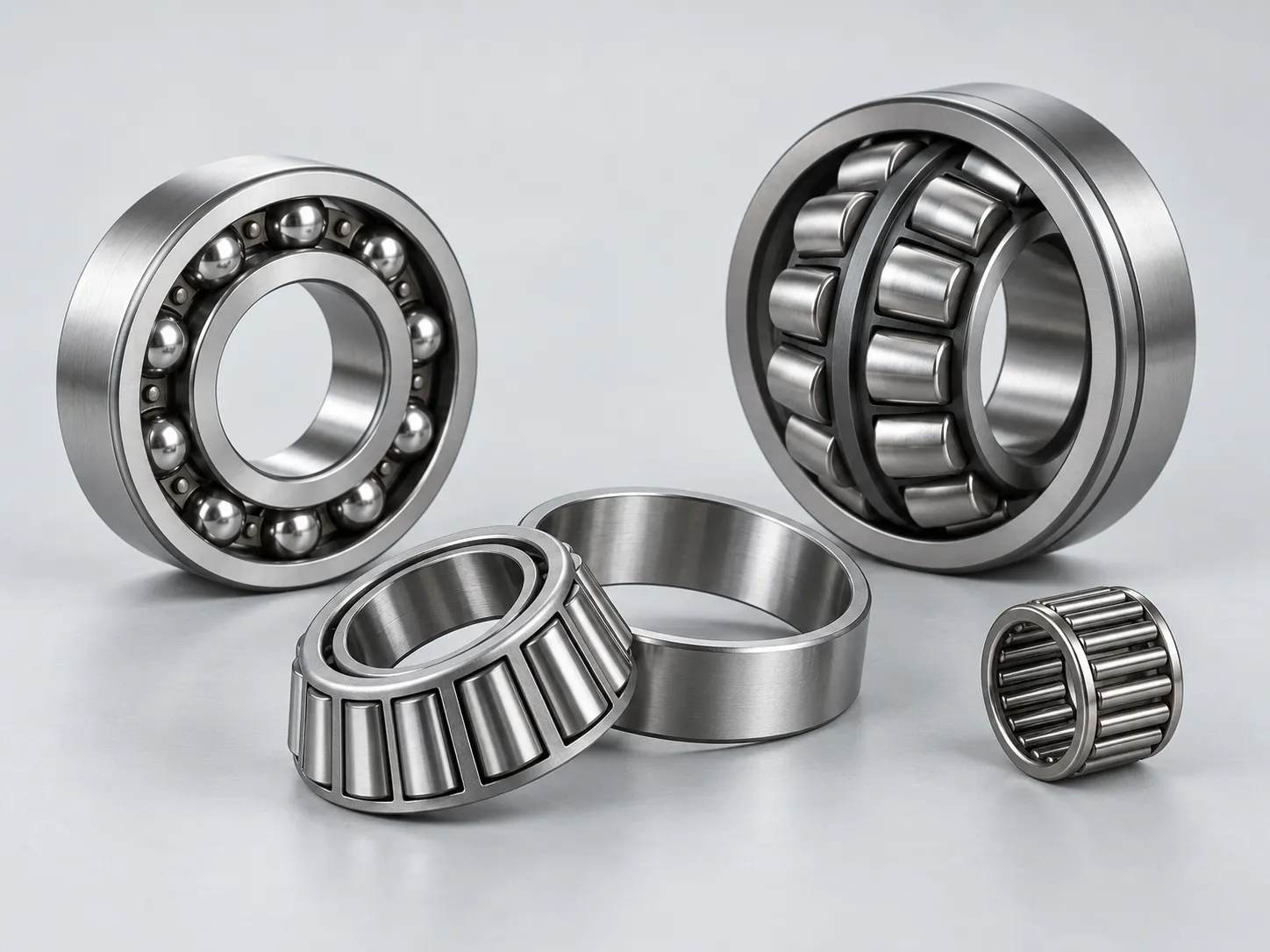
Representative image of thin-section bearings
Representative image

Thin-Section Bearings

Thin-section bearings are large-bore rolling bearings with a small, often constant cross-section across a size series. Their slender rings reduce package space and rotating mass while providing controlled motion for robotics, optical equipment and other assemblies where conventional bearing envelopes are too bulky.

Key facts

Family
Bearings
Common types
Radial contact, Angular contact, Four-point contact, Open bearing, Shielded bearing, Sealed bearing
Materials
Bearing steel, Stainless steel, Brass separator, Polyamide cage, NBR seals
Used in
Robot joints, Medical scanners, Wafer handling, Optical gimbals, Radar equipment

Types

  • Radial contact
  • Angular contact
  • Four-point contact
  • Open bearing
  • Shielded bearing
  • Sealed bearing

Materials

Applications

  • Robot joints
  • Medical scanners
  • Wafer handling
  • Optical gimbals
  • Radar equipment

What to send for a quote

  • bore and outside diameter
  • cross-section
  • contact type
  • closure style
  • material and precision

Questions about thin-section bearings

What should I send to identify thin-section bearings?

Send bore and outside diameter, cross-section, contact type, closure style, material and precision. Measure the square cross-section carefully and state whether dimensions follow an inch series or metric design. A clear photograph, drawing or readable reference can resolve details that dimensions alone do not show.

How should I select thin-section bearings?

Match radial, angular or four-point geometry to load direction, moment, stiffness, accuracy, space and mounting distortion. Confirm the mating parts and operating environment before ordering, since an apparently similar size can use a different profile, material or internal arrangement.

Last updated: