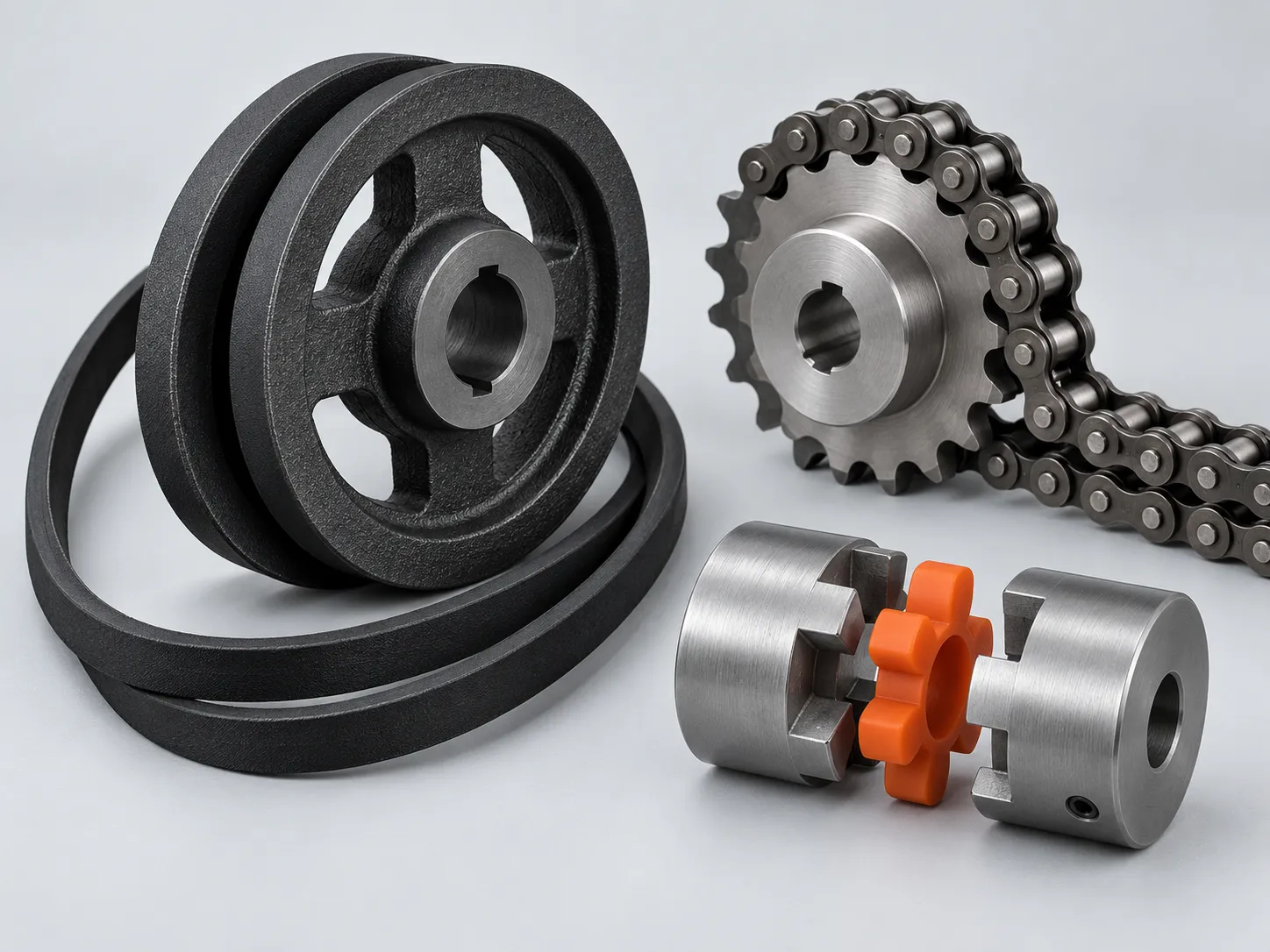
Representative image of flexible couplings
Representative image

Flexible Couplings

Flexible couplings are shaft connectors that transmit torque while accommodating limited angular, parallel or axial misalignment. Jaw, tyre, gear and other constructions use elastomer deformation or controlled metallic movement to reduce shock and vibration between a driver and driven machine.

Key facts

Common types
Jaw coupling, Tyre coupling, Gear coupling, Pin-and-bush coupling, Grid coupling, Disc coupling
Materials
Cast iron, Forged steel, Polyurethane, NBR, Natural rubber, Stainless steel
Used in
Motor-pump sets, Conveyor drives, Generator sets, Compressors, Rolling mill tables
Types

  • Jaw coupling
  • Tyre coupling
  • Gear coupling
  • Pin-and-bush coupling
  • Grid coupling
  • Disc coupling

Materials

Applications

  • Motor-pump sets
  • Conveyor drives
  • Generator sets
  • Compressors
  • Rolling mill tables

What to send for a quote

  • coupling type
  • torque, power and speed
  • both shaft diameters
  • keyway dimensions
  • misalignment and environment

Questions about flexible couplings

What should I send to identify flexible couplings?

Send coupling type, torque, power and speed, both shaft diameters, keyway dimensions, misalignment and environment. Measure both hubs and the flexible element separately, and record any bore taper, keyway or flange bolt pattern. A clear photograph, drawing or readable reference can resolve details that dimensions alone do not show.

How should I select flexible couplings?

Choose coupling principle, size and element from torque, speed, service factor, shaft spacing, misalignment and torsional behaviour. Confirm the mating parts and operating environment before ordering, since an apparently similar size can use a different profile, material or internal arrangement.

Last updated: