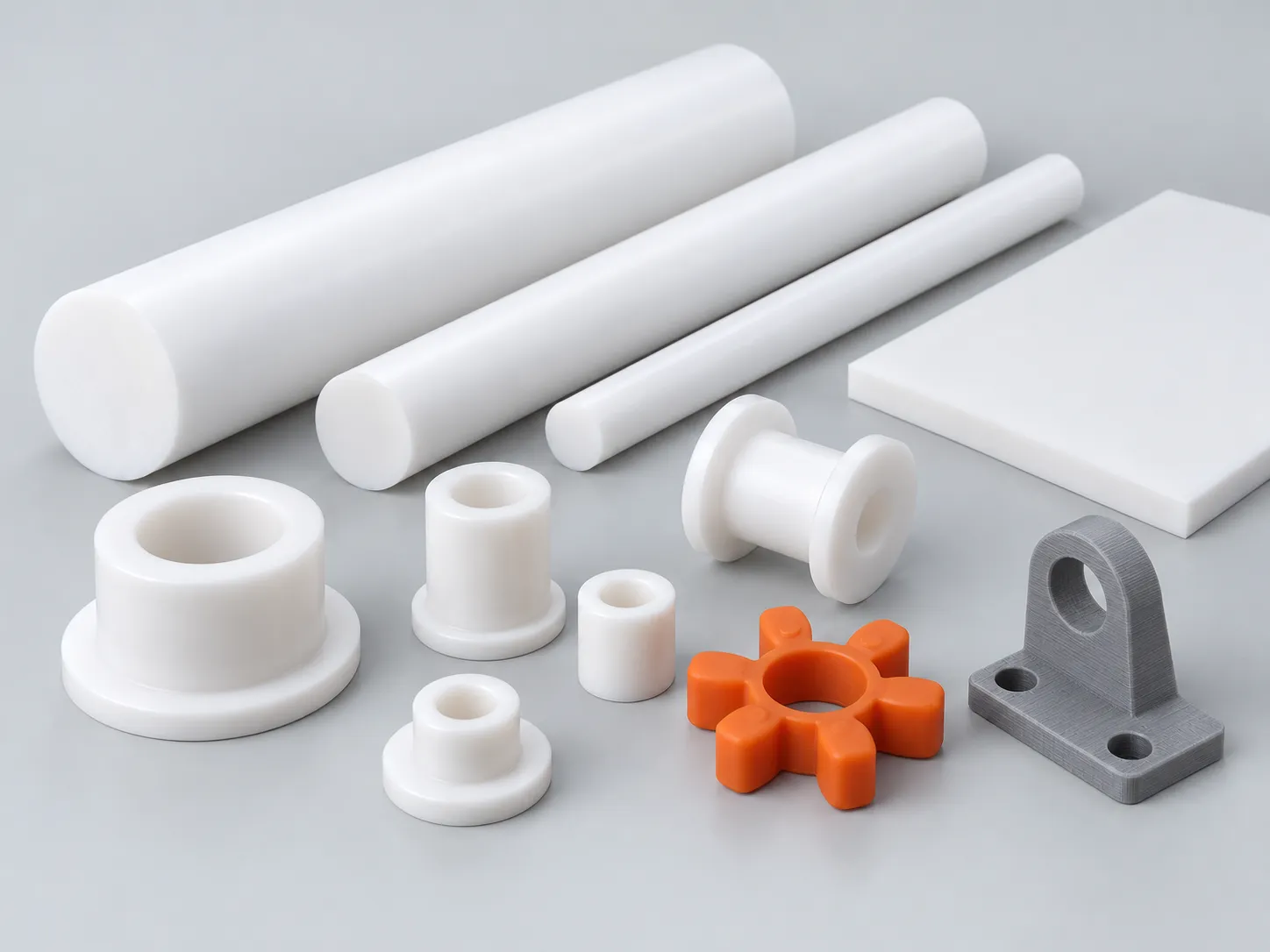
Representative image of 3d-printed industrial parts
Representative image

3D-Printed Industrial Parts

3D-printed industrial parts are additively built polymer components created layer by layer from a digital model. The process supports prototypes, jigs, guards, ducts and complex low-volume replacements without conventional tooling, while material, orientation and finishing must be validated for the intended load and environment.

Key facts

Common types
Fused-filament part, Powder-bed polymer part, Flexible elastomeric part, Carbon-fibre reinforced part, Vapour-finished part
Materials
Polyamide 11, Polyamide 12, PEEK, Thermoplastic polyurethane, PETG, Carbon-fibre reinforced polyamide
Used in
Functional prototypes, Machine jigs, Protective covers, Legacy replacements, Fluid manifolds

Types

  • Fused-filament part
  • Powder-bed polymer part
  • Flexible elastomeric part
  • Carbon-fibre reinforced part
  • Vapour-finished part

Materials

Applications

  • Functional prototypes
  • Machine jigs
  • Protective covers
  • Legacy replacements
  • Fluid manifolds

What to send for a quote

  • 3D CAD model
  • material and process need
  • loads and environment
  • quantity
  • finish and tolerance

Questions about 3d-printed industrial parts

What should I send to identify 3d-printed industrial parts?

Send 3D CAD model, material and process need, loads and environment, quantity, finish and tolerance. Mark critical faces, threads and sealing surfaces on the model so allowances and secondary machining can be planned. A clear photograph, drawing or readable reference can resolve details that dimensions alone do not show.

How should I select 3d-printed industrial parts?

Choose process, material, build direction and post-treatment from strength, heat, chemicals, porosity, surface and dimensional needs. Confirm the mating parts and operating environment before ordering, since an apparently similar size can use a different profile, material or internal arrangement.

Last updated: